Showing posts with label educational. Show all posts

Tuesday, April 20, 2010

Tips of the Day: What is Shutter Speed?

Shutter speed is the amount of time that the shutter is open.

In film photography it was the length of time that the film was exposed to the scene you’re photographing and similarly in digital photography shutter speed is the length of time that your image sensor ’sees’ the scene you’re attempting to capture.


Thanks to Mr.Google for this image.

Shutter speed is measure in seconds. The bigger the number, the faster the shutter close. For example, 1/4000 is faster than 1/50. It's usage is depends on whether and lights. If you are using speed lower than 1/60, you will need to use tripod if your hands shaking or some types of image stabilization like IS(Canon), SteadyShot(Sony), or VR(Nikon).

Shutter speed is depends on your type of composition where you want to take a long shot (eg. slow shutter speed light trails) or fast shot (eg. freeze motion, fast speed). Some cameras will give you slow shutter in low light due to small aperture lens (eg. f/4.5, f/5.3, f/6.7) and will force you to use flash or tripod to make the image stable.

Focal Length and Shutter Speed is another thing to consider when choosing shutter speed is the focal length of the lens you’re using. Longer focal lengths will accentuate the amount of camera shake you have and so you’ll need to choose a faster shutter speed (unless you have image stabilization in your lens or camera). The ‘rule’ of thumb to use with focal length in non image stabilized situations) is to choose a shutter speed with a denominator that is larger than the focal length of the lens. For example if you have a lens that is 50mm 1/60th is probably ok but if you have a 200mm lens you’ll probably want to shoot at around 1/250.

References: http://digital-photography-school.com/shutter-speed

Wednesday, April 7, 2010

Tips of the Day: Rule of Thirds


The “Rule of Thirds” one of the first things that budding digital photographers learn about in classes on photography and rightly so as it is the basis for well balanced and interesting shots.

The basic principle behind the rule of thirds is to imagine breaking an image down into thirds (both horizontally and vertically) so that you have 9 parts. As follows.


As you’re taking an image you would have done this in your mind through your viewfinder or in the LCD display that you use to frame your shot.

With this grid in mind the ‘rule of thirds’ now identifies four important parts of the image that you should consider placing points of interest in as you frame your image.

Not only this – but it also gives you four ‘lines’ that are also useful positions for elements in your photo.

The theory is that if you place points of interest in the intersections or along the lines that your photo becomes more balanced and will enable a viewer of the image to interact with it more naturally. Studies have shown that when viewing images that people’s eyes usually go to one of the intersection points most naturally rather than the center of the shot – using the rule of thirds works with this natural way of viewing an image rather than working against it.

An Example:


Sources: http://digital-photography-school.com/rule-of-thirds

Friday, April 2, 2010

Tips of the Day: How to change DSLR lens quickly?


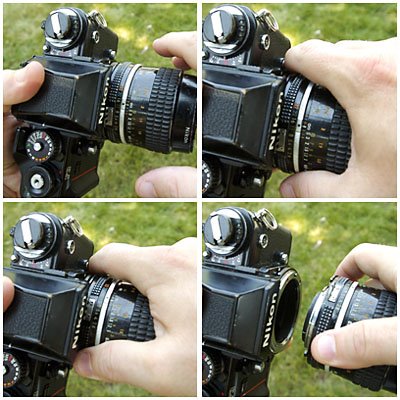
In an event it is impossible to take the picture with the only lens. Sometimes we have to change it. For example, the wedding ceremony photo shoot session which some photographer like to take candid pictures of the people. It is imposible to take a candid pictures with short zoom lens or kitlens like 18-55mm, 28-80mm and 16-80mm. Except when you have the wide telephoto lens like: eg. 18-250mm, 28-200mm, and 28-300mm. To change the lens, you will need to follow this 4 simple steps:

1) Hold your camera in your left hand as shown in the upper left part of the top photo. Approach the lens as shown with your right hand open and the right forefinger extended a little.

2) As seen in upper right, when you close your hand around the lens, depress the lens release button with the left side of your right forefinger.

3) Moving onto lower left, rotate the lens clockwise (for Nikon, reverse for Canon & Sony) and let the forefinger slide along the still-depressed release button.

4) Finally, as seen at lower right, the lens slides smoothly off of the camera and leaves with your right hand.

Hope this helps! Thanks for viewing!

Thursday, April 1, 2010

What is Aperture?


Aperture is ‘the size of the opening in the lens when a picture is taken.’

When you hit the shutter release button of your camera a hole opens up that allows your cameras image sensor to catch a glimpse of the scene you’re wanting to capture. The aperture that you set impacts the size of that hole. The larger the hole the more light that gets in – the smaller the hole the less light.

Aperture is measured in ‘f-stops’. You’ll often see them as f/number – for example f/2.8, f/4, f/5.6,f/8,f/22 etc. Moving from one f-stop to the next doubles or halves the size of the amount of opening in your lens (and the amount of light getting through). Keep in mind that a change in shutter speed from one stop to the next doubles or halves the amount of light that gets in also – this means if you increase one and decrease the other you let the same amount of light in – very handy to keep in mind).

One thing that causes a lot of new photographers confusion is that large apertures (where lots of light gets through) are given f/stop smaller numbers and smaller apertures (where less light gets through) have larger f-stop numbers. So f/2.8 is in fact a much larger aperture than f/22. It seems the wrong way around when you first hear it but you’ll get the hang of it.

Sources: Digital Photography School
Read More: http://digital-photography-school.com/aperture